CIO Lens Q4 2026: When risks converge
In this quarter's CIO Lens, our investment experts discuss positioning across public and private markets in a world of rising risks.
Autheurs
In this quarter's CIO Lens:
Click the play button above to watch Johanna's latest video or read her column below:
For the past few years, I’ve encouraged everyone to ignore the headlines and focus on the medium-term trends. Looser fiscal policy, the AI boom, higher defence spending and a focus on securing supply chains in a geopolitically uncertain world all pointed to stronger nominal growth which is great for equities. From a cyclical perspective we are still in a very strong environment for growth. However, the risks are rising and these are the indicators I am watching closely.
Firstly, the conflict in Iran has continued for longer than anyone expected. We can't predict the outcome but we know that the supply buffers in energy markets - floating storage and strategic reserves - have largely been exhausted. This means that we must remain alert to the possibility of persistently high energy prices which, in turn, complicate the outlook for central banks. Keep an eye on oil (as well as gasoline, diesel and jet fuel) and gas prices.
Which brings me onto the next point: bonds. I've always said that bond yields would be the ultimate constraint on this bull market in equities. In an environment of inflationary, rather than deflationary, shocks and profligate fiscal policies, equity markets can be sustained by higher nominal growth as long as bond investors are willing to fund the borrowing.
The last few months saw significant volatility in bond yields and, with the AI boom being increasingly debt-financed, well-functioning bond markets are even more important. The recent rate hike in the US indicated that Fed Chair Warsh understands the importance of maintaining the credibility of the Fed which should keep yields under control for now.
However, I expect these concerns to resurface given our expectations for strong growth and the inflationary risks caused by the Middle East conflict.
At what point do bond yields become a major risk for equities? I would break this into two phases:
We are currently in phase 1, where rising bond yields raise the bar for equity performance because they represent a competing asset to generate return and because the level of corporate bond yields sets the hurdle for corporate performance, particularly in AI where data-centre financing deals are yielding 10% now.
Our equity / bond valuation models are not flashing yet and, despite huge capex requirements, hyperscaler balance sheets remain exceptionally strong from a credit perspective. For now, our equity investors still believe that the scale of the AI opportunity is under-estimated, AI adoption continues and the revenues of the hyperscalers and frontier labs are surging.
Phase 2 would be when bonds sell off because of concerns about the sustainability of debt. We are not there yet. In the US, strong growth is helping to keep the show on the road and bond markets are already providing some fiscal discipline to European governments. The rise in bond yields over the summer was driven by rate expectations rather than volatility at the long end of the yield curve.
However, the medium-term trend given an ageing population is that government spending will continue to rise. The trigger for these concerns to come to the fore could be a more significant rate shock caused by higher-than expected-inflation or a meaningful slowdown in growth which would expose the underlying debt dynamics.
We are still in phase 1, where the beneficial impact of higher nominal growth on equities is outweighing the risks for bonds. We therefore favour equities over bonds but as bond yields rise the burden of proof is increasing.
Equities (+) +
We began the quarter with a positive view on equities, supported by expectations of a low risk of recession in the US, resilient corporate earnings and continued investment in artificial intelligence. Although valuations appeared stretched and market returns remained concentrated, the broader economic backdrop continued to favour a pro-cyclical stance.
As the quarter progressed, we broadened our exposure beyond the technology sector, increasing our emphasis on European industrials and defence stocks while opening positions in energy and mining companies. Following strong performance across Asian technology markets, we subsequently took profits in this area at the end of the quarter, while retaining a positive view on the Nasdaq.
We retain a positive view on equities. However, our conviction is increasingly tempered by elevated earnings expectations, market concentration and the extent to which the constructive growth outlook is already reflected in valuations.
Government bonds (0) +
We entered the quarter with a neutral view on government bonds. Persistent inflation risks, fiscal pressures and uncertainty around the path of monetary policy continued to cloud the outlook, leaving us cautious despite yields having drifted higher.
Over July, rises in yields meant valuations appeared more attractive, as rate expectations became more realistic. This supported a more constructive outlook in the short term. We established a tactical long position in the US 10-year Treasury, benefiting from positive carry while also providing some diversification should the constructive growth outlook weaken.
We retain confidence in central banks' ability to navigate policy appropriately and view duration as a useful complement to our pro-cyclical positioning. We therefore end the quarter with a small positive tactical view on government bonds. Market expectations for US interest rate policy are now more closely aligned with our own, although the position remains sensitive to inflation developments and confidence in the Federal Reserve's willingness to adopt an appropriately restrictive policy stance.
Commodities (+) +
We started the quarter with a positive view on commodities, focused primarily on industrial metals and energy-related exposures. Resilient global growth, infrastructure investment and demand associated with artificial intelligence continued to support industrial metals, while geopolitical tensions and supply constraints underpinned the outlook for energy.
Later in the period, we retained exposure to energy and mining companies and re-established a position in gold. Elevated real yields, renewed institutional demand and improved investor positioning created a more attractive medium-term opportunity. Gold also continued to offer protection against inflation, sovereign debt concerns and risks to central bank credibility.
We therefore continue to maintain a positive view on commodities. Energy and industrial metals remain underpinned by geopolitical risks, supply constraints and resilient structural demand, while central bank purchases and improving investment flows are expected to push up the price of gold.
Credit (-) -
We maintained a negative view on credit throughout the quarter. Although corporate fundamentals remained broadly resilient, tight spreads continued to offer limited compensation for refinancing risks and any gradual deterioration in the economic outlook.
During the quarter, elevated issuance and rising leverage reinforced our concerns, particularly within US investment grade credit. The substantial financing requirements associated with artificial intelligence investment also increased the risk of further issuance and greater concentration within parts of the market.
We remain negative on credit, particularly the US investment grade sector. With spreads historically tight and the return profile increasingly asymmetric, we continue to prefer taking cyclical risk through equities rather than credit.
Since our last update in July, macro risks have increased. Conflicts in the Middle East and Ukraine have shown signs of further escalation, while the AI-driven capex cycle has continued.
On the other hand, the partial decoupling and uneven recovery of private markets continues to present selective opportunities to enhance overall portfolio diversification and resilience.
Market pressures are growing
Tensions in the Middle East have continued to rise and the risk of a substantially prolonged conflict remains. Disruption to energy supply and transport routes could keep inflation elevated and weaken growth globally. Elsewhere, the war in Ukraine has also escalated again, including attacks on energy infrastructure, adding another potential source of stress on energy markets.
Meanwhile, the AI-driven spending cycle has persisted. As with previous investment booms associated with breakthrough technologies, there is a risk that expectations and valuations eventually correct. The timing is uncertain, but this risk warrants attention as capital deployment, debt financing and market concentration continue to increase.
Enterprise value in both listed and private markets has become increasingly concentrated in a relatively small number of AI-related companies. The IPO of SpaceX at a record USD 1.8 trillion valuation has further contributed to concentration in listed markets especially. The boom in memory chip maker valuations is another driving factor.
Advances in AI are also raising concerns about disruption to traditional industries, particularly parts of the software sector. Earlier this year, those concerns coincided with pressure from inflated valuations and high leverage, especially in Covid-era fund vintages, contributing to stress in parts of the private debt market.
In our view, however, AI disruption risk is not uniform across software. Some business models are genuinely exposed, while for others AI is neutral or even potentially beneficial. This is already visible in the more bifurcated recovery of listed software valuations since the initial correction earlier this year. By contrast, the valuation and leverage overhang appears more concentrated in large US buyouts from the 2021–22 vintages and related debt exposure.
Diversification and resilience in private market portfolios is key
With typical holding periods for new investments of three to five years – and in some cases much longer – private market investors need to look beyond the current macro and market situation and position their portfolios for a range of scenarios.
Given the partial decoupling in recent years between listed markets and large parts of private markets – notably buyouts, infrastructure equity and real estate, which have been in a general slowdown since the 2021 peak – we see attractive, selective entry opportunities for strategies that can provide resilience and diversification.
Venture capital and private equity secondaries are the exceptions to the observed decoupling. Venture valuations have rebounded strongly, driven by AI, while secondaries, and continuation investments in particular, have continued to grow through the cycle. Our research further suggests the growth of continuation investments is overwhelmingly structural, rather than cyclical, in nature.
We continue to favour areas characterised by disciplined valuations, operational value creation, diversified income streams and strong demand drivers.
Private Equity: uneven recovery, selective opportunity
Private equity continues to move gradually from recalibration towards recovery, but the improvement remains narrow. The broader recovery in deployment and distributions has yet to become established.
For new investments, the preceding private equity slowdown is positive as it means entry conditions are generally healthy. We favour smaller and mid-market buyouts, where entry valuations remain meaningfully below those seen in large-cap transactions and operational value creation can be the primary driver of returns.
Existing large US buyout investments, meanwhile, continue to work through the overhang created by the post-Covid software investment boom. AI disruption, by contrast, is more company-specific than sector-wide: it may add pressure to exposed software business models, while others could benefit over the long term. This makes careful underwriting of AI exposure important across private equity portfolios.
Secondaries and continuation investments have continued to grow through the cycle, with record H1 2026 volumes, and remain attractive sources of liquidity and access to high-quality assets.
Venture and growth capital have similarly diverged from the rest of private equity, with valuations rebounding to new records across stages, led by late-stage AI premiums. This makes high selectivity crucial – and we see relatively more attractive opportunities in early-stage investments across industry sectors.
Private Debt and Credit Alternatives: broaden the income toolkit
Credit markets have remained resilient in 2026, supported by healthy corporate earnings, strong labour markets and continued consumer spending. Consumer credit performance in particular continues to normalise, with underlying fundamentals supportive despite pockets of weakness in lower-quality borrowers.
While concerns around leverage and credit expansion are building in some areas, these risks remain unevenly distributed. Meanwhile, large financing needs associated with AI infrastructure, combined with ample investor demand for credit in this area, have contributed to easier lending conditions and a compression of risk premia.
This underscores the defining feature of today's market: increasing dispersion. Investors are no longer being compensated equally for taking additional credit risk, making sector selection, collateral quality and structural protections increasingly important.
In our view, areas supported by strong collateral fundamentals, regulatory inefficiencies or less efficient market structures, including areas of securitised credit and asset-based lending strategies such as infrastructure and real estate debt, remain among the most attractive opportunities for generating risk-adjusted income.
Insurance-linked securities can further enhance diversification, as returns are primarily driven by natural catastrophe risk rather than economic or credit conditions, although softer reinsurance pricing calls for greater selectivity.
Infrastructure: selectivity and delivery
Infrastructure equity strategies focused on the global energy transition continue to benefit from powerful structural tailwinds. Energy security, electrification and rising power demand remain supportive of long-term investment, while growing AI adoption and data-centre deployment are creating additional demand.
However, the nature of the opportunity is evolving. Much of the first phase of the energy transition focused on deploying new generation capacity. Today, in many markets, the greater challenge is no longer producing electricity but delivering it to where it is needed, when it is needed. Grid constraints, interconnection delays, permitting bottlenecks and a lack of system flexibility are increasingly emerging as limiting factors on growth.
For investors, this creates a more differentiated opportunity set. Following the sector's valuation reset, we continue to see attractive opportunities in operational infrastructure, selectively in development platforms and in assets that address system constraints. In our view the most attractive investments are those that help energy, capital and data move efficiently through the system, rather than simply adding incremental capacity.
Real Estate: selective opportunities amid slower recovery
Global real estate markets continued their selective recovery in the first half of 2026, with transaction volumes rising, led by the US and EMEA, and capital values broadly stable or modestly higher.
However, the recovery following several years of repricing and adjustment has been slower and less uniform than previously anticipated, and some of the first-half activity likely reflects deals agreed before the Middle East conflict escalated.
Near-term headwinds also remain significant. Higher financing costs, macro uncertainty and the potential for further rate increases could slow the pace of improvement, while refinancing needs continue to expose differences between assets and owners.
At the same time, elevated construction costs and a growing gap between construction costs and existing asset values continues to restrict new development. The resulting shortage of modern, high-quality space is supporting rental growth, particularly in Europe and in prime locations.
Attractive opportunities therefore continue to be found where pricing has adjusted most meaningfully, and investors can combine disciplined deployment with active asset management. We continue to favour sectors where needs-based resilience and operational improvement can unlock alpha, including urban logistics, living and storage formats. Recapitalisations are also increasingly important as owners seek liquidity and capital structures are reset.
- Read more: Private markets investment outlook Q4 2026
60% of the world’s largest asset owners have made public climate commitments or statements, mostly targeting reductions in portfolio carbon emissions1. Most of those commitments were made between 2020 and 2022, a period in which climate policies were strengthening and decarbonisation momentum was gathering pace. Since then, political ambition and action have stalled, ambition across the corporate world has waned and the market’s willingness to reward climate action has dropped.
Against that more challenging backdrop, some asset owners are reconsidering whether their objectives, strategies and targets line up. The three components are different and targets should be a result of first two rather than the starting point. Objectives establish the outcome sought; strategies explain how investors intend to contribute; targets make progress measurable and time-bound. Revisiting how progress is measured should not be confused with lowering ambition.
Organisations have many climate objectives. Different objectives require different strategies, even if an ultimate outcome is to “reduce portfolio emissions”. Where the objective is to support real-economy decarbonisation, the relevant question is not simply how quickly portfolio emissions fall, but what is changing in the businesses held. As the market’s willingness to reward companies better placed for decarbonisation has waned – amid stalling political momentum, rallying fossil fuel stocks and faltering clean energy expectations – tensions which were previously masked have become clearer.
Below, we map nine climate related aims and approaches. Drawing on 48 academic and practitioner studies, we have examined which reinforce one another and where tensions arise. Objectives which are most closely aligned are closer together and those where tensions are greater are further apart. The analysis highlights a distinction between changing portfolio exposures and supporting change in the businesses held.
Mapping institutional investors' climate objectives
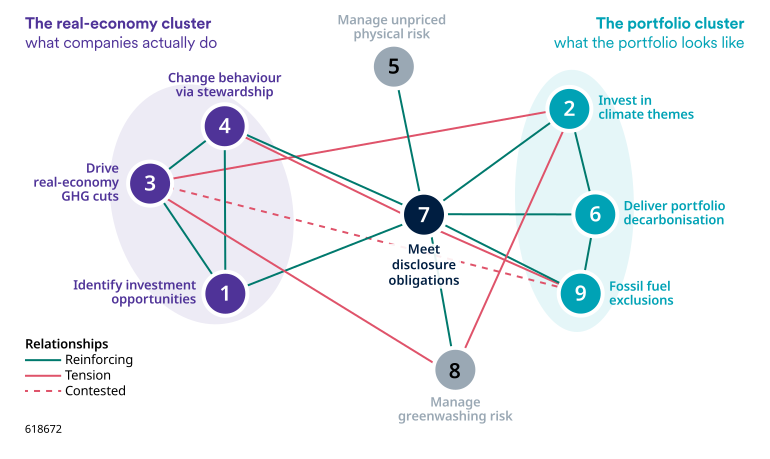
Source: Schroders' analysis based on academic studies considering relationships between different objectives
Not all objectives – and the strategies which deliver them – are in tension. Physical-risk assessment is relevant under either approach, while disclosure is an obligation across strategies rather than a competing investment objective. The clearest distinction is between changing a portfolio’s holdings and supporting change in the companies and assets it owns.
The former can lower reported portfolio emissions by reducing exposure to carbon-intensive companies and sectors. That can be appropriate where the objective is to reduce such exposures or meet explicit investment restrictions. Those constraints make it mathematically easy to meet emission targets, but they also shrink the investment opportunity set, reduce diversification and can undermine performance.
The latter – investing in companies as they decarbonise – is slower. The pace of decarbonisation in individual companies is dwarfed by the speed of trading exposure from high- to low-carbon companies. It is also more difficult; it requires analysis of companies’ decarbonisation prospects and active engagement with management teams. But it allows investors to maintain exposure to (selected) higher-emitting businesses, limits the costs of reduced diversification, and provides exposure to the outperformance transitioning companies have historically delivered.
The first strategy is appropriate – indeed necessary – to deliver targets which require rapid reductions in portfolio emissions in the short term. The latter approach requires different measures, focusing on longer term objectives or tracking companies’ decarbonisation progress rather than portfolio aggregates. The challenge is to ensure targets, strategies and objectives are consistent.
Until a few years ago, the tension seemed academic; portfolio decarbonisation and performance went hand-in-hand. That changed with the war in Ukraine and then the Middle East and although the equation is starting to reverse, the last few years have reminded us that exclusions and portfolio constraints can interfere with performance goals and that targets which require them can become challenging.
For our part, our climate strategy has always emphasised investment in the companies and assets which are transitioning, rather than treating a lower portfolio footprint as an end in itself. Our client conversations suggest that some asset owners are looking for ways to ensure their objectives, strategies and targets line up.
The task is not simply to loosen or tighten climate targets. It is to be clear about the outcome they are meant to deliver, the actions intended to achieve it and the evidence that demonstrates progress.
1 Schroders analysis of publicly available disclosures for the Thinking Ahead Institute AO100 universe and evidence verified in July 2026. Of the 100 asset owners, 46 had explicit climate targets and a further 14 indicated public discussion without an identified qualifying commitment.
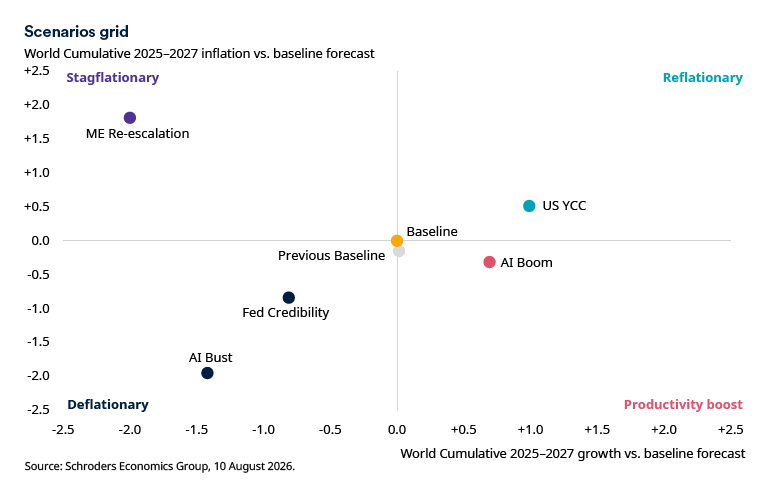
Fed credibility: A revised policy framework causes markets to lose confidence in the Fed's commitment to price stability, as the FOMC delivers fewer rate hikes than expected, allowing inflation to remain elevated. Investors demand greater compensation for longer-term inflation risks, driving term premia higher and a steepening of the Treasury curve. Slowing growth and persistent inflation weigh on US assets, resulting in a weaker dollar. By Q4, the US economy slips into recession, while softer demand pushes oil prices lower.
Middle East re-escalation: Tensions in the Middle East re-escalate, pushing oil prices to $150 per barrel, driving inflation significantly higher and raising the risk that price pressures become entrenched. These dynamics exacerbate risks around food and fertiliser prices, tipping the global economy into recession, with net energy importers such as the eurozone, UK, Japan and parts of Asia bearing the brunt. Central banks are forced to hike rates in response to the inflation shock but, with recession taking hold by Q4, a policy reversal will mean rate cuts arriving in H2 2027.
US yield curve control: A more proactive US Treasury introduces yield curve control in Q4, pinning the 30-year Treasury yield at 4%. While looser financial conditions provide a modest boost to US growth, outflows of foreign capital curb growth in the trade deficits, meaning additional demand fuels much higher inflation and a large depreciation of the dollar. A reallocation of capital flows outside of the US means that stronger currencies and easier financial conditions support a non-inflationary acceleration in growth.
AI boom: Rapid adoption of AI results in a period of robust, investment-led economic growth that boosts productivity, but widespread automation begins to displace workers, lifting unemployment and weighing on consumer spending. The surge in capex drives energy demand higher, but productivity gains and weaker consumption outweigh these pressures.
AI bust: An AI bubble in the global equity market bursts in Q4 as it becomes clear that the sector cannot deliver on lofty expectations. Capex spending reverses, and consumer spending weakens as a mild recession causes unemployment to rise while tumbling stock markets hit sentiment. Meanwhile, weaker growth eases inflation pressures and allows central banks to lower interest rates which eventually generates a consumer-led cyclical recovery.
Subscribe to our Insights
Visit our preference center, where you can choose which Schroders Insights you would like to receive.
Autheurs
Topics