Saving for retirement? Why investing sustainably makes sense for you
With interest rates expected to remain low, individuals are likely to need to contribute more to have the retirement they want. We see a need for a greater active asset management and sustainable investing when saving for our pensions.

Authors
In the long term, we believe the ability of companies to create value is intrinsically linked to their ability to navigate changing social and environmental pressures. Environmental and social trends are long term in nature and well aligned to the time horizon of the contributions invested for retirement, which typically remain untouched for many years, if not decades.Additionally, although people generally do not hold themselves as most responsible in mitigating issues such as climate change, they do undeniably contribute to a more sustainable society, from the brands they choose to shop with to the funds they choose to invest in – they all have an impact.
Evidence that investing sustainably makes sense over the longer term
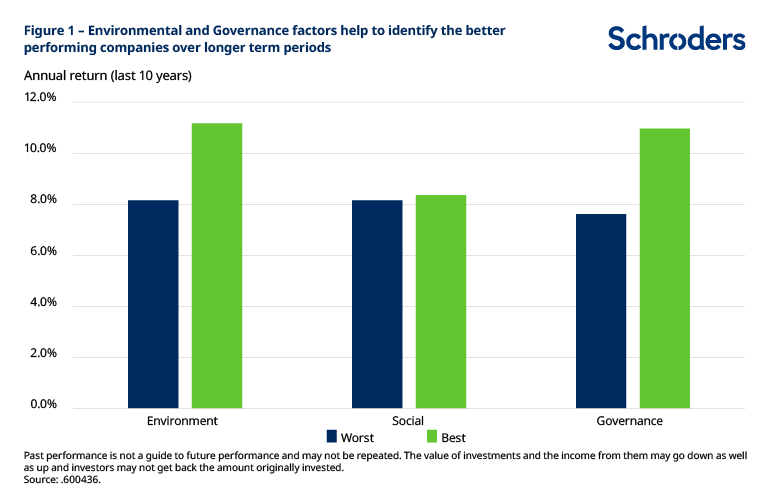
Recent work by MSCI1 demonstrated that Environmental (E), Social (S) and Governance (G) issues help to better understand the risks that companies face and the link between ESG information and the valuation and performance of companies. The effectiveness of E, S and G also depends on the time period over which the analysis is carried out, as can be seen in Figure 1. We found that companies that had high (good) scores from an environmental and governance perspective outperformed companies that scored poorly over the next 10 years; this was most marked with the governance factor. Over shorter time periods, we evaluated whether E, S and G factors could reduce the impact of the stock market losses (often referred to as drawdowns). As can be seen from Figure 2, generally companies with better ESG scores outperformed those with poor ESG scores during drawdowns. Those companies with better ‘E’ scores did well in 2020 during the Covid crisis, but this may be driven more by differences in sector performance directly related to the pandemic, such as the underperformance of the energy sector.
1https://www.msci.com/documents/10199/03d6faef-2394-44e9-a119-4ca130909226
Past performance is not a guide to future performance and may not be repeated. The value of investments and the income from them may go down as well as up and investors may not get back the amount originally invested. Source: Schroders, Refinitiv. 30 September 2020. Sustainability scores use SustainEx, a robust objective framework to measure the ESG costs companies impose, or the benefits they provide, which are not currently recognised as financial costs or benefits.
Information importante: Cette communication est destinée à des fins marketing. Ce document exprime les opinions de ses auteurs sur cette page. Ces opinions ne représentent pas nécessairement celles formulées ou reflétées dans d’autres supports de communication, présentations de stratégies ou de fonds de Schroders. Ce support n’est destiné qu’à des fins d’information et ne constitue nullement une publication à caractère promotionnel. Le support n’est pas destiné à représenter une offre ou une sollicitation d’achat ou de vente de tout instrument financier. Il n’est pas destiné à fournir, et ne doit pas être considéré comme un conseil comptable, juridique ou fiscal, ou des recommandations d’investissement. Il convient de ne pas se fier aux opinions et informations fournies dans le présent document pour réaliser des investissements individuels et/ou prendre des décisions stratégiques. Les performances passées ne constituent pas une indication fiable des résultats futurs. La valeur des investissements peut varier à la hausse comme à la baisse et n’est pas garantie. Tous les investissements comportent des risques, y compris celui de perte du principal. Schroders considère que les informations de la présente communication sont fiables, mais n’en garantit ni l’exhaustivité ni l’exactitude. Certaines informations citées ont été obtenues auprès de sources externes que nous estimons fiables. Nous déclinons toute responsabilité quant aux éventuelles erreurs commises par ou informations factuelles obtenues auprès de tierces parties, sachant que ces données peuvent changer en fonction des conditions de marché. Cela n’exclut en aucune manière la responsabilité de Schroders à l’égard de ses clients en vertu d’un quelconque système réglementaire. Les régions/secteurs sont présentés à titre d’illustration uniquement et ne doivent pas être considérés comme une recommandation d’achat ou de vente. Les opinions exprimées dans le présent support contiennent des énoncés prospectifs. Nous estimons que ces énoncés reposent sur nos anticipations et convictions dans des hypothèses raisonnables dans les limites de nos connaissances actuelles. Toutefois, aucune garantie ne peut être apportée quant à la réalisation future de ces anticipations et opinions. Les avis et opinions sont susceptibles de changer. Ce contenu est publié au Royaume-Uni par Schroder Investment Management Limited, 1 London Wall Place, London EC2Y 5AU. Société immatriculée en Angleterre sous le numéro 1893220. Agréé et réglementé par la Financial Conduct Authority.