CIO Lens Q3 2026: Concentration, credibility and the importance of understanding risk
In this quarter's CIO Lens, our investment experts highlight why resilience and genuine diversification matter as market concentration builds around AI, even with Middle East tensions easing.
Autheurs
In this quarter's CIO Lens:
Click the play button above to watch Johanna's latest video or read her column below:
At the end of last year, I highlighted two risks we had to watch: the credibility of the Federal Reserve (Fed) and debt sustainability, and artificial intelligence (AI). Where have we got to?
Central bank credibility intact for now
First, bonds. Confronted with a more populist turn in policy in recent years, we have consistently been of the view that more profligate fiscal policies would boost nominal growth and, by extension, corporate earnings. The ultimate constraint on this trend would be the extent to which bond investors would be willing to fund government spending.
For now, news on this front has been comforting for me. We saw a sell-off in bond yields in the second quarter driven by concerns about energy-induced stagflation but yields are back at fair value, rate expectations are more realistic, and an easing of tensions in the Middle East has alleviated the risk of inflation in the short-term.
Central banks have shown a willingness to “tap on the brakes” by raising rates and, for now, new Fed Chair Kevin Warsh’s policy pronouncements have indicated that he understands the importance of maintaining the credibility of the Fed.
Some commentators have been concerned about the step away from dot plots and forward guidance, but I view this as a sensible adjustment in a world of more frequent supply shocks and a return to the more pragmatic policies of the 1990s and 2000s. After all, the dot plot was only introduced in 2012.
The challenge of achieving real diversification in equities
What about equities? Here we are starting to see more extreme behaviour and expensive valuations. A lot is made of the concentration of the index but this misses the point slightly. In fact, compared to previous years, equity performance has been less dominated by the Mag 7, and indeed the Mag 7 in aggregate has been flat year to date.
Concentration has actually been a much bigger issue in terms of index contributions: this year, 20 stocks in MSCI ACWI have accounted for 74% of the return of the entire index with AI-related sub sectors such as memory being key drivers of this trend. Markets are chasing any capital equipment company with an AI datacentre angle, and in many cases, capitalising these earnings with high multiples.
Furthermore, exposure to the AI theme extends into private markets and, increasingly, part of the credit markets. That means that portfolios may be less diversified than asset class labels would imply. This is a key concern for our investors. Our latest Global Investor Insights Survey found that diversification is a top portfolio objective for 84% of respondents. How should investors manage this risk?
Several clients have asked me about allocating to equal cap weighted indices as a way of reducing concentrated exposure to AI. I fear that this tool is too blunt. Stock specific risks associated with concentrated contributions to return may not be effectively hedged with unrelated, arbitrarily selected stocks. Equal-weighting can introduce unintended stylistic tilts - such as weaker balance sheets, higher leverage, greater rate sensitivity, more volatile earnings, lower profitability and reduced liquidity.
At this point, I would favour style diversification as a means of managing AI risk and increasing the resilience of one’s portfolio. Here, recent trends have been extreme. Over 12 months, Momentum is up 33% vs 17% for Quality and 21% for Value. High quality businesses are now trading at valuations that appear attractive relative to their own history (see chart below).
The catalyst for this disconnected pricing is a pervasive fear of change and disruption by generative AI and the new competition it enables. The market is currently pricing very low growth into many exceptional companies, but history and our own fundamental analysis suggest that in many cases this fear is unwarranted.
Developed markets (ex-US) valuation spreads (top quintile compared to the market average) 1987 to April 2026
.svg)
At the same time, active approaches to Value provide diversification to the AI theme. A disciplined Value selection process will steer investors to precisely where peak market euphoria is not - beware passive Value indices, however, as the AI theme has infiltrated some of the traditional value sectors such as utilities and real estate as well!
Value equities have had a low correlation with AI-stocks
Rolling 24-month correlation: S&P 500 pure value vs S&P 500 semiconductors & equipment index
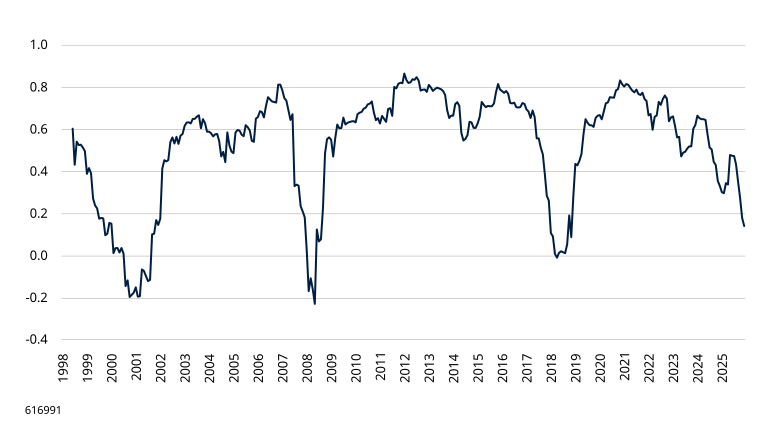
Past performance is not a guide to future performance and may not be repeated.
Value is S&P 500 pure value total return index, semis are S&P 500 semiconductors and equipment total return index. Semiconductors used as a proxy for AI-stocks. Data covers 30 June 1996 (inception of S&P 500 semiconductors & equipment index) to 31 December 2025. Source: LSEG Datastream, S&P and Schroders.Value equities have delivered significantly better outcomes in down-markets for AI-stocks
Median quarterly return in quarters where semiconductors fall
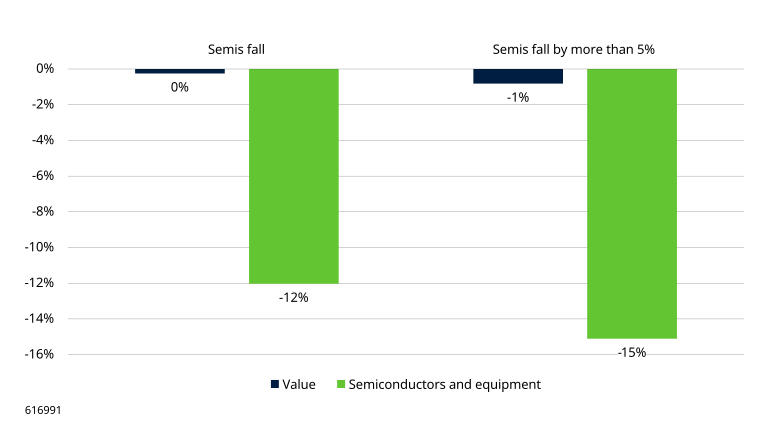
Past performance is not a guide to future performance and may not be repeated.
Source: LSEG Datastream, S&P and Schroders. Value is MSCI pure value total return index, semis are S&P 500 semiconductors and equipment total return index. Semiconductors used as a proxy for Al-stocks. Data covers 30 June 1996 (inception of S&P 500 semiconductors & equipment index) to 31 December 2025. Chart isolates those quarters where semis fell in value; non-overlapping periods are used.
Where are risks accumulating?
I was at lunch with friends recently, and everyone was asking me about SpaceX. My investment advice is always dull - I believe in the compounding of returns and the careful balancing of risk and return through time so there's no point coming to me for "exciting" stock tips.
I'm even more boring today: investors face a world where market concentration is high, economic exposures are increasingly interconnected and valuations are stretched.
The challenge is not simply finding opportunities but understanding where risks accumulate. It is more important than ever to understand what you own, how these exposures fit together and what role each exposure plays in your portfolio.
With low chance of recession and stable yields, we still see upside in equities, but my suggestion for the summer is to lean back from some of the frothiest parts of the equity market, diversify your equity risk, and wear sunscreen.
Securities/sectors/regions mentioned are for illustrative purposes only and not a recommendation to buy or sell any security.
Equities (+) +
We began the quarter with a constructive view on equities, supported by resilient earnings, continued investment in artificial intelligence and a low probability of recession. While geopolitical tensions and higher energy prices created greater uncertainty, corporate profits remained robust and helped underpin market performance.
As the quarter progressed, we looked to broaden our exposure beyond the technology sector. We maintained exposure to AI-related themes while increasing our emphasis on financials, industrials and resource-related sectors, helping to diversify as the market cycle matures.
We therefore retain a positive view on equities. Although valuations remain elevated in some areas, earnings momentum and long-term investment trends continue to favour the asset class.
Government bonds (-) 0
We entered the quarter with a negative view on government bonds, reflecting concerns around persistent inflation, fiscal sustainability and the risk that markets were underestimating how long interest rates would remain elevated.
During the quarter, bond markets underwent a significant repricing. Higher yields improved valuations, leading us to close the short position and move to a neutral stance. At the same time, the macroeconomic backdrop became more balanced as growth concerns emerged alongside ongoing inflation risks.
While valuations are now more attractive than they were at the start of the year, inflation risks remain elevated and fiscal pressures continue to cloud the outlook. We therefore maintain a neutral view on government bonds overall.
Commodities (0) +
We began the quarter with a neutral view on commodities, having previously taken profits following the sharp rise in energy prices. However, we remained constructive on selected areas, particularly agriculture and gold, where supply-side pressures and geopolitical uncertainty continued to create opportunities.
During the quarter, our focus within commodities evolved as market conditions and valuations changed. While we subsequently took profits in agriculture and gold, we identified new opportunities in industrial metals and energy-related sectors, supported by structural demand linked to artificial intelligence infrastructure, electrification and resource security initiatives.
We therefore end the quarter with a positive view on commodities, although our preferred exposure is increasingly through resource and energy-related equities rather than direct commodity holdings.
Credit (-) -
We maintained a cautious stance on credit throughout the quarter. Although corporate fundamentals were generally resilient, spreads continued to offer limited compensation for inflation, duration and refinancing risks.
Credit spreads remain tight despite increasing issuance and a backdrop of inflation uncertainty, refinancing risks and slower growth. Stronger earnings momentum elsewhere in markets has also reinforced our preference for taking risk through equities rather than credit.
We therefore retain a negative view on credit, particularly within investment grade markets, where the risk-reward profile remains unattractive.
The past quarter has provided another reminder that uncertainty remains the defining feature of today's investment environment. While financial markets have demonstrated remarkable resilience in the face of geopolitical tensions, policy uncertainty and shifting economic expectations, the underlying drivers of volatility have not disappeared.
Recent developments in the Middle East illustrate this dynamic clearly. The agreement of a fragile truce in Iran has reduced immediate fears of a broader regional escalation and helped stabilise markets. Yet, a durable peace settlement remains to be agreed, leaving the potential for renewed disruption. Meanwhile, economic consequences from the prolonged pressure on global energy supply will linger.
At the same time, risk assets have recovered strongly. Global equity markets have rebounded to new highs, driven largely by a narrow group of technology and AI-related companies. Investor enthusiasm has been further supported by high-profile technology listings and expectations of a broader reopening of capital markets.
However, market concentration remains a key risk in both listed and private markets – and valuations across parts of the technology sector continue to reflect very optimistic assumptions about the pace and scale of AI-driven growth.
Diversification and resilience define portfolio priorities
Overall, while sentiment has improved since our last outlook, the broader investment landscape and experience over the past two years reinforce the importance of focusing on resilience as a guiding portfolio construction principle.
As we stated in our last outlook, this is not merely about preserving capital during brief periods of stress. Rather it is about constructing portfolios able to generate attractive returns over time, despite persistent macroeconomic and external challenges.
This view is reflected clearly in Schroders’ latest Global Investor Insights Survey. Reflecting the views of more than 1,000 investors and intermediaries with combined assets under management of around $72 trillion, it found:
- 85% of respondents expect greater market volatility over the next year.
- Conflict in the Middle East (69%), uncertainty over US foreign policy and global leadership (67%), and threats to energy security (60%) were the most-cited concerns.
- Diversification (84%) and downside protection (83%) were seen as the most important portfolio priorities.
Importantly, the survey also highlights a broader shift in how investors are approaching portfolio construction. Rather than viewing public and private markets as separate allocation decisions, investors are increasingly assessing opportunities across the entire investment universe to achieve their specific objectives.
Specifically, approximately half of investors now assess opportunities across public and private equity and credit markets together rather than through separate allocation frameworks. In all cases, strategies across the public-private continuum are used to achieve specific portfolio goals.
Structural and cyclical tailwinds
It is no surprise to us that investors are recognising the important role private markets have to play within broader allocation frameworks, especially in the current climate.
Alongside their structural characteristics – including longer investment horizons, reduced sensitivity to short-term market sentiment and access to specialist opportunity sets – many private market segments continue to benefit from a cyclical decoupling that creates attractive entry points compared to public market peers.
Notably, many areas of private markets remain in the fifth year of a slowdown in terms of fundraising, with early signs of a recovery in investment and exit activity by value, but not by number, creating attractive entry points even as public equity markets trade near record highs.
At the same time, private markets are not immune to challenges. Liquidity remains constrained in some areas, and recent headlines surrounding redemption pressures in selected semi-liquid vehicles have drawn greater scrutiny. However, these issues should not be mistaken for a broad deterioration in underlying fundamentals. In many cases, they reflect structural liquidity mismatches, concentrated exposures or vintage-specific dynamics, rather than systemic weakness.
Selectivity is key
These distinctions matter because resilience within private markets varies significantly. Some strategies have demonstrated greater ability to navigate economic uncertainty, inflationary pressures and market dislocation than others.
- In private equity, small and mid-sized buyouts and continuation vehicles have proven more resilient than large buyouts, and continue to benefit from a favourable capital demand/supply balance.
- In venture, euphoria over technology IPOs has pushed valuations to above their 2021 peak across stages, especially in later-stage and AI-related rounds, which should be treated with caution.
- In private debt, scrutiny regarding direct lending focused on software-related large companies in the US contrasts with the structural soundness of the wider private debt and credit alternatives universe.
- In real estate, the gap between prime and commodity assets has never been wider.
- In infrastructure, operational assets with contracted revenues are gaining scarcity value, while a renewed focus on energy security is expected to bring tailwinds for energy transition assets.
Selectivity therefore remains critical. Across private equity, private debt, infrastructure and real estate, we continue to favour segments characterised by disciplined valuations, operational value creation, diversified income streams and structural demand drivers. This reflects our long-held views – we believe the current environment reinforces, rather than alters, this positioning.
Private Equity: From recalibration to recovery
Private equity continues to move gradually from recalibration towards recovery. Fundraising remains subdued, especially for buyouts. Meanwhile deal and exit value improved through the first half of 2026, although activity became more concentrated and volumes by deal count actually fell.
This all continues to support attractive entry points to the asset class, while at the same time the record SpaceX IPO, alongside anticipated listings from OpenAI and Anthropic, could in due course help to reopen the broader exit and IPO market, supporting liquidity.
We continue to see the most attractive opportunities in small and mid-market buyouts, where entry valuations remain significantly below large-cap transactions and operational value creation remains the primary driver of returns. Venture and growth have seen valuations shift higher, making selective deployment particularly important.
Private Debt and Credit Alternatives: Selective opportunity
Private debt continues to attract increased scrutiny, particularly around direct lending focused on software-related large companies in the US. Based on our analysis, much of this concern remains concentrated around a relatively small number of large US transactions originated during the exceptionally exuberant 2021–22 period, rather than signalling broader deterioration across the asset class.
As market dispersion increases, investors are no longer being paid equally for all forms of credit risk and instead are being rewarded for selectivity. Infrastructure debt, real estate debt, asset-backed finance and insurance-linked securities offer exposure to different return drivers, collateral pools and risk characteristics than traditional corporate lending, supported by contractual cashflows, hard assets and diversified borrower pools.
Against a backdrop of heightened geopolitical uncertainty, tighter valuations and policy uncertainty, diversified credit strategies backed by contracts, assets and essential services continue to provide resilient income alongside attractive risk-adjusted return potential.
Infrastructure Equity: Structural tailwinds, selective opportunities
Infrastructure equity, and energy transition infrastructure specifically, continue to benefit from powerful structural tailwinds, with energy security, electrification and rising power demand supporting long-term investment opportunities.
Recent geopolitical developments have reinforced the importance of domestically generated and flexible sources of power, while AI adoption and data centre growth continue to drive demand for infrastructure capacity. Following a meaningful valuation reset, many operational infrastructure assets now offer some of the most attractive entry points in over a decade.
We continue to favour operational assets with diversified revenue streams, selective development and platform opportunities created by the repricing of risk capital, and grid flexibility and storage solutions benefiting from increasing system complexity. In our view, infrastructure remains well positioned to deliver resilient, income-driven returns, although outcomes are increasingly driven by asset selection and active management.
Real Estate Equity: Poised for recovery
Global real estate appears increasingly positioned for a recovery following several years of repricing and adjustment. Transaction activity is improving, valuations have largely reset and constrained development pipelines are creating supportive supply dynamics across many sectors.
The recovery remains uneven and near-term headwinds persist. Economic uncertainty, elevated financing costs and the lingering effects of geopolitical disruption could slow the pace of improvement. Nevertheless, attractive opportunities are emerging across sectors and regions where pricing has adjusted most meaningfully.
We continue to favour sectors where there is needs-based resilience and operational improvement can unlock alpha, such as urban logistics, and both living and storage formats. Overall, the market backdrop suggests that disciplined deployment should benefit from favourable entry points and rising cash-on-cash yields. Additionally, refinancing requirements and capital constraints are creating attractive recapitalisation and secondaries opportunities that may offer compelling entry points for experienced investors.
The mood at London Climate Action Week (LCAW) 2026 was one of pragmatic urgency. As over 75,000 delegates descended on the UK capital to attend over 1,000 events, the narrative decisively shifted from “why” we must transition to “how” we finance it.
Against a backdrop of geopolitical fragmentation and energy security concerns, there is a growing acceptance of the gap opening between the political commitments made in Paris in 2015 and the tangible action policy makers, corporates and the real economy are making to deliver those ambitions.
Perhaps counterintuitively, as evidence of transition has waned and concerns over the effects of its physical consequences have grown, the case for investing selectively in the transition has strengthened. A thoughtful, active approach to climate finance can reward investors while delivering the real-world decarbonisation the planet urgently needs.
The valuation opportunity in the transition gap
The pace of real-economy decarbonisation has undeniably slowed. Policy progress toward net-zero alignment has stalled in recent years, and Climate Action Tracker estimates that the policies governments have put in place leave us on track for temperature rises of 2.6 degrees by the end of the century, well short of the two degree commitment in the Paris Agreement.
That shortfall in action is well recognised and reflected in financial market valuations. We have examined the pace of decarbonisation implied by equity valuations using a Gordon Growth framework to estimate the pace of transition reflected in the valuations of listed companies better prepared for decarbonisation through either lower emissions, exposure to clean solutions, or through the strength of their transition plans. That data shows that the market is currently pricing in a slower transition than either models suggest is necessary or pace which is likely given the policy changes we have seen.
Comparing expected decarbonisation rates to the pace reflected in valuations
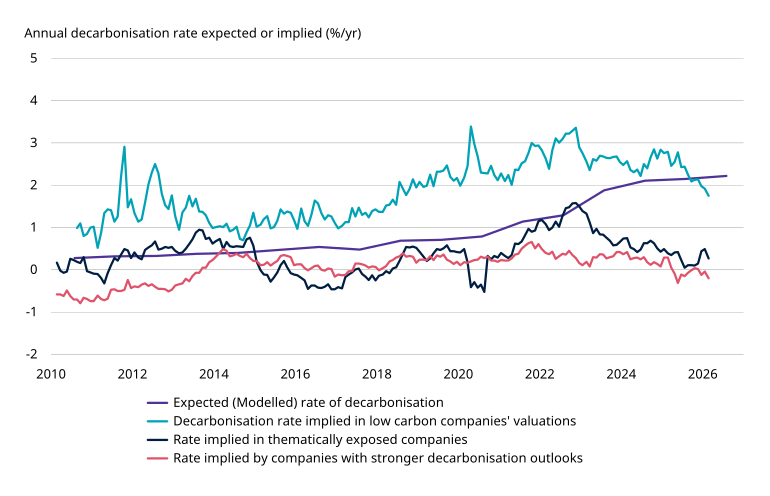
Source: Schroders analysis. Implied-decarbonisation rates are model estimates using a Gordon Growth Model framework on carbon- vs less-carbon-exposed companies; results are sensitive to calibration assumptions.The rates of decarbonisation implied are calculated on a sector-relative basis, comparing better vs worse placed peer companies to mitigate the effects of performance differences across sectors.
This embedded pessimism is a strength. Lower market expectations mean there is less valuation risk in holding transitioning companies today. When markets have discounted faster rates of decarbonisation, faltering expectations or delivery missteps put investment returns at risk. The transition toward a low carbon economy is inevitable – even if the timing is uncertain – and low expectations embedded in valuations presents opportunities to capture significant upside as action inevitably accelerates.
Investing in the climate transition is undoubtedly getting harder. Filtering investment universes for companies with already-low emissions has provided a relatively straightforward solution to portfolio decarbonisation on paper. Going forward, more selectivity will be needed and valuation discipline will be important.
Our emphasis has been on companies well placed to deliver transition. Over the past decade, companies actively cutting their emissions and transitioning their business models most quickly have outperformed peers by around 4% annually. Our Climate Transition Model is designed to help us identify future beneficiaries of that tailwind.
Conclusion
The macro case for transition investing has strengthened. Real-economy decarbonisation has slowed, leaving the transition under-priced by the market. However, capturing this value requires more than a simplistic model or a passive sector tilt.
The same principles hold beyond climate investing. The global geopolitical backdrop is becoming more complex, fast-changing and uncertain. The long-term direction is often much easier to discern than near-term prospects. Focusing on companies well placed to benefit in the long term, at attractive valuations, is harder than applying simple screens or tilts, but provides compelling opportunities.
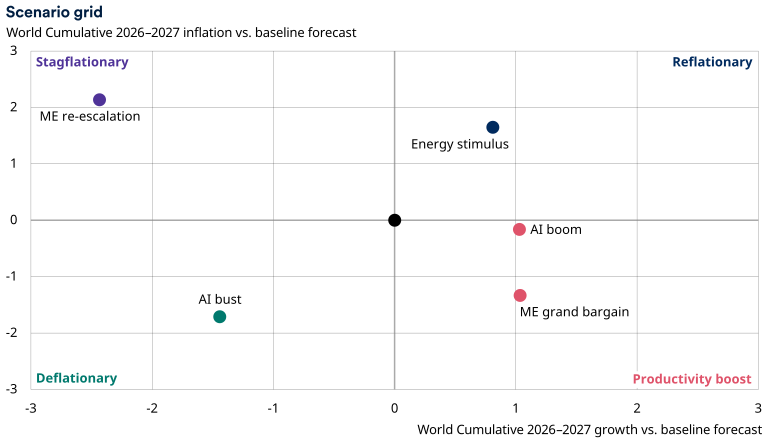
Source: Schroders Economics Group, 5 May 2026
Baseline: We entered the year expecting growth to beat expectations, but the inflation shock due to events in the Middle East means we have trimmed our growth forecasts. Energy prices dominate the newsflow and we assume they will remain elevated until Q3. However, broad price pressures, coming through food and manufactured goods, are also likely to squeeze real incomes and weigh on growth. As a result, we now expect global GDP growth of 2.5% this year and 2.6% in 2027, down from 2.9% and 2.7% respectively. We see global inflation at 3.3% for 2026 (vs 2.4% previously) and at 2.7% for 2027 (vs 2.4%).
Middle East grand bargain: A diplomatic breakthrough between the US and Iran results in a comprehensive sanctions relief deal, with the UAE also raising output significantly outside of OPEC, creating a global oil supply glut. Energy prices fall sharply, extinguishing the near-term inflation impulse and preventing food price pressures from becoming entrenched through 2027. With inflationary fears fading, central banks gain room to cut rates, supporting risk assets and broader global growth into 2027. The deal ultimately delivers a disinflationary growth dividend felt most acutely in net energy importers such as the Eurozone, UK and Asia.
Middle East re-escalation: Tensions in the Middle East re-escalate, pushing oil prices to $150 per barrel, driving inflation significantly higher and raising the risk that price pressures become entrenched. These dynamics exacerbate existing baseline risks around food and fertiliser prices, tipping the global economy into recession with net energy importers such as the Eurozone, UK, Japan and parts of Asia bearing the brunt. Central banks are forced to hike rates in response to the inflation shock but, with recession taking hold by Q4, a policy reversal will mean rate cuts arriving in H2 2027.
Energy stimulus: Governments respond to elevated war risk and energy insecurity by deploying large-scale fiscal stimulus, shielding consumers with energy subsidies and ramping up defence spending. Rather than dampening demand, this wave of intervention actively drives oil and food prices higher, opening the door to broader, stickier inflation into 2027. Solid growth and even higher inflation mean that central banks are forced to hike rates and keep them higher for longer, with higher bond yields testing government balance sheets
AI boom: Rapid adoption of AI results in a period of robust, investment-led economic growth that boosts productivity, but widespread automation begins to displace workers, lifting unemployment and weighing on consumer spending. The surge in capex drives energy demand higher, but productivity gains and weaker consumption outweigh these pressures, consistent with new Fed Chair Warsh's view that AI is structurally disinflationary, giving central banks room to cut rates and supporting broader global growth into 2027.
AI bust: An AI bubble in the global equity market bursts in Q3 as it becomes clear that the sector cannot deliver on lofty expectations. Capex spending reverses, and consumer spending weakens as a mild recession causes unemployment to rise while tumbling stock markets hit sentiment. Meanwhile, weaker growth eases inflation pressures and allows central banks to lower interest rates that eventually generates a consumer-led cyclical recovery.
Subscribe to our Insights
Visit our preference center, where you can choose which Schroders Insights you would like to receive.
Autheurs
Topics