Institutional Investor Study 2022: geopolitical risk and climate weigh on confidence
Institutional investors see rising inflation and interest rates, geopolitical tensions and a global economic slowdown as the main threats to performance in 2022.

Authors
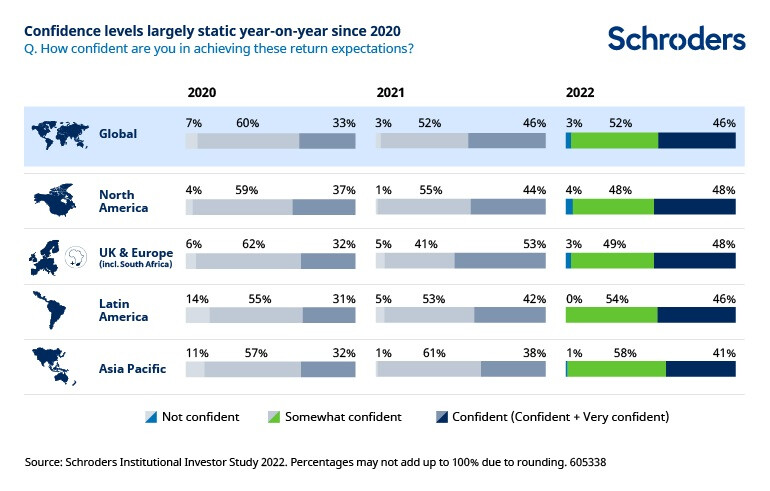
Nervousness among institutional investors remains, with under half of the respondents (46%) to the annual Schroders Institutional Investor Study saying they are confident of achieving their expected returns in 2022.
Rising inflation and interest rates, geopolitical uncertainty and a global economic slowdown are among the main issues concerning respondents. These were identified as the main factors that they expect to influence the performance of their portfolios in 2022.
The study, which was carried out in March 2022, sought the opinions of 770 institutional investors in 28 locations around the world. The respondents represent a spectrum of institutions, including corporate and public pension plans, insurance companies, endowments and foundations, collectively responsible for US$27.5 trillion in assets under management.
Rising concern among institutional investors across the board
Such a high level of concern among institutional investors has never been recorded in the four years we have conducted the Institutional Investor Study. At least half of those polled perceive as many as seven different factors as being highly threatening to their portfolio performance in the next 12 months.
While the Covid-19 pandemic has declined as a significant influence, oil prices, the tapering of monetary policy and global supply chain disruptions are also now major influencing factors on portfolio performance.
Keith Wade, Chief Economist at Schroders, says: “After many years of loose monetary policy, investor concerns are dominated by the rise in inflation and the policy response from central banks. Geopolitical risks have also risen in the wake of the Russian invasion of Ukraine adding further uncertainty to an outlook where an increasing and significant number expect a global economic slowdown. “
While anxiety around the impact of pandemics is fading, climate risk is becoming increasingly influential in the minds of institutional investors. This focus on the risk posed by climate change (31% in 2022, compared to 21% in 2021) will have an impact on both our natural habitat and the global economy.
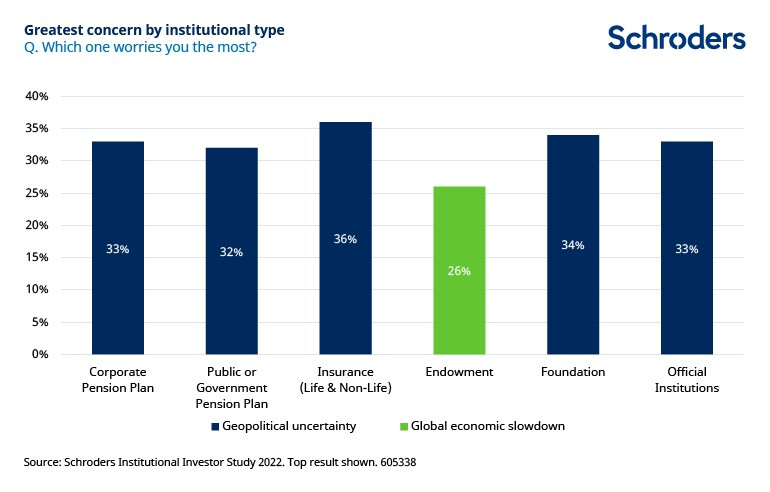
For nearly all institutional investors, geopolitical uncertainty is the most concerning issue at present, following Russia’s invasion of Ukraine and the implications for the global economy. The exception is in endowments, where a global economic slowdown is a bigger worry.
Return expectations for the next five years down compounded by the market volatility in 2022
More broadly, investors’ return expectations for the next five years have deteriorated compared with a year ago, compounded by the significant concerns raised above. The average expected return over the next five years in 2022 has declined, with fewer investors expecting that their return will be above 6% than in 2021 (42% in 2022 compared to 47% in 2021). The proportion of investors estimating an annual return of 4% or less rose to 27% in 2022, from 17% in 2021.
Johanna Kyrklund, Schroders Group Chief Investment Officer and Co-Head of Investment, said:
“Markets continue to be caught in the cross currents of concerns about rate increases and worries about recessionary risks. The Study found that investors’ allocations to equities have dipped, reflecting our own house positioning. Indeed, determining what other positions to own around that core defensive position in equities requires a view on whether rates or growth risks are most important.
“Our conclusion is to continue to focus predominantly on the consequences of rising rates because traditional inflation models are vulnerable to supply bottlenecks caused by a myriad of unprecedented sources, post-pandemic spending patterns, lockdowns in China and the war between Russia and Ukraine. This leaves central banks focused on normalising policy above all else.”
Adoption of cryptocurrency varies by region
One in 10 global institutional investors are currently invested in cryptocurrency assets and the rates of adopting these types of assets varies across different regions. In Latin America, 22% of investors say they are currently holding these types of assets and more than one-third of them said they would consider investing in the next 12 months.
By contrast, in North America, 6% of respondents are currently invested in cryptocurrency assets and only 13% said they would consider investing in the next 12 months. In Europe, 9% are currently invested and 17% said they would be willing to invest in the next year. However, 40% of respondents in Europe said they are not invested in cryptocurrencies and would not consider investing in the future, the highest figure among all those polled.
Portfolio allocations to developed market equities are expected to decline to 30% in 2022 from 32% in 2021 while allocations to emerging market shares are expected to rise to 10% from 9% in 2021. Allocations to private assets are expected to remain unchanged at 13% in 2022.
About the Schroders Institutional Investor Study
Schroders commissioned CoreData to conduct the sixth Institutional Investor Study to analyse the world’s largest investors’ key areas of focus and concern including the macroeconomic and geopolitical climate, return expectations, asset allocation and attitudes to sustainability and private assets.
The respondents (770 globally) represent a spectrum of institutions including corporate and public pension plans, insurance companies, official institutions, endowments and foundations, collectively responsible for US$27.5 trillion in assets. The research was carried out via an extensive global survey during March 2022.
Zapisz się na nasze Analizy
Odwiedź nasze centrum preferencji, gdzie możesz wybrać, które Analizy przygotowane przez Schroders chcesz otrzymywać.
Authors
Tematy